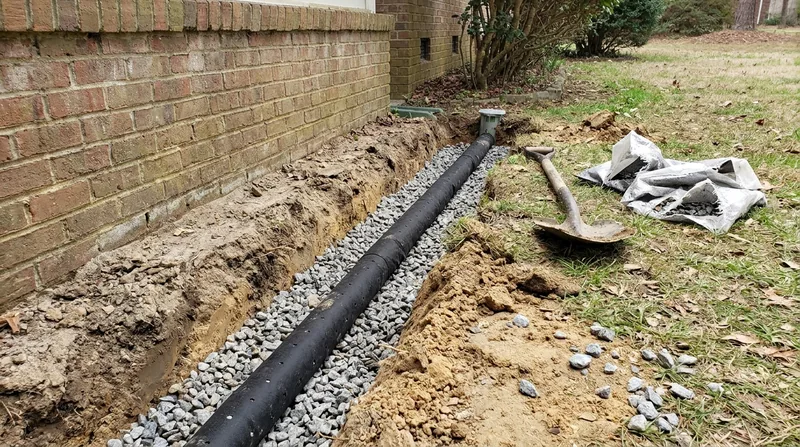




French Drain Installation in Greenville: Keep Groundwater Away From Your Foundation
Greenville sits on flat coastal plain ground, sandy loam over silty clay, with a water table that stays high long after the rain stops. Around College Hill, downtown, and the streets near East Carolina University, most 1920s to 1950s brick and frame houses sit on brick piers or slabs, and water has nowhere to run. In Brook Valley, Red Banks, and Westhaven, the 1950s to 1970s brick ranches face the same problem: slow runoff and saturated soil pushing against the footing. French Drain Installation in Greenville intercepts that groundwater before it reaches your foundation wall, using graded gravel, fabric-wrapped pipe, and a discharge that actually works on a flat lot. We install these systems for homeowners across Greenville and the surrounding towns, and we tell you plainly when a drain is the right fix and when the water is coming from somewhere else. Start with a free basement inspection so we can trace where the water is actually entering.
Why French Drain Installation Matters on Greenville's Flat, Wet Ground
Most of the Greenville metro does not have full basements, so the water problem shows up at the foundation line instead: damp block, efflorescence, a musty smell in the lowest room, and slab edges that stay wet for days. The Tar River floodplain backs water up after tropical storms and heavy downpours, and the silty clay layer under the sandy topsoil drains slowly. When the water table rises, hydrostatic pressure builds against the footing and finds the weakest point. A properly built exterior French drain gives that water a path away from the house instead of through it.
- It intercepts groundwater along the foundation wall before it reaches the footing.
- It relieves hydrostatic pressure that causes wall seepage and slab dampness.
- It handles the slow runoff typical of flat lots in Red Banks and Westhaven.
- It ties to daylight or a sump basin, whichever your grade allows.
On a lot with almost no fall, the discharge point matters as much as the pipe, and that is where a generic trench job usually fails.
Key info: A 1950s brick ranch in Brook Valley with a wet slab edge after every summer storm is a classic flat-lot case. The drain has to run to a sump basin and pump, because there is no daylight grade within reason. We check that before we quote anything.
For official guidance on drainage and grading rules in the city, check the City of Greenville building department pages, since local requirements vary and must be verified before work begins.
How We Install a French Drain Around a Greenville Foundation
We start by walking the grade and finding where the water actually collects, not where it looks wet on the surface. On slab-on-grade subdivisions in Winterville and Ayden, that often means checking downspout discharge and window well drainage before we dig a trench. Then we lay out the run, confirm the discharge point, and only then cut ground. The goal is a drain that still works in year ten, not just after the first rain.
- We mark the trench line along the foundation wall and confirm the slope to the discharge point.
- We excavate to depth, keeping the trench clear of the footing and any buried utilities.
- We line the trench with filter fabric so silty clay soil does not clog the gravel.
- We set perforated pipe in graded gravel, holes down, with a consistent fall.
- We wrap the gravel in fabric and backfill with care around the foundation wall.
- We tie the run to daylight or to a sump basin with a check valve on the discharge line.
- We test the system with water and correct the grade before we leave.
Every run gets tested before we call it finished, because a drain that ponds at the low end is worse than no drain at all.
Key info: In Grifton and Farmville, where lots are flat and the water table stays high, we often pair the exterior run with an interior drain tile system so water that gets past the wall still has a path to the sump. One system does not always cover the whole problem.
French Drain Approaches We Use in Greenville
Not every lot gets the same build. The right approach depends on your grade, your foundation type, and where the water needs to end up. Here is how we match the method to the property.
| Approach | Description | Best for |
|---|---|---|
| Gravity drain to daylight | Fabric-wrapped gravel and perforated pipe running to a lower discharge point on the lot. | Lots with enough fall to move water away without a pump. |
| Drain to sump basin | Exterior run tied into a sump basin with a pump and check valve on the discharge line. | Flat lots in Red Banks and Westhaven where daylight grade is not available. |
| Footing drain retrofit | New drain placed along the footing line where the original drain tile has failed or clogged. | Older brick and frame houses near downtown and College Hill. |
| Surface and downspout correction | Grading and downspout extension work that sends roof water away from the foundation before it soaks in. | Slab-on-grade homes in Winterville and Ayden with wet slab edges. |
| Combined exterior and interior | Exterior run plus interior perimeter drain for water that still reaches the wall. | High water table lots where one system cannot carry the volume. |
We pick the approach after we see the grade and the water, not from a standard package.
French Drain Installation Cost in Greenville: What to Expect
French drain pricing starts at $25 per linear foot, and that figure covers a standard run with fabric, gravel, and perforated pipe. The final number depends on how deep we have to go, how long the run is, and where the water has to discharge. A lot that needs a sump basin and pump costs more than one with a daylight outlet, and a footing drain retrofit on an older brick house takes more care than a simple surface run.
Access matters too. A narrow side yard between a house and a fence in Westhaven slows the work, and so does a run that has to cross a driveway or a buried utility line. We price the job from what we see on site, not from a phone description. Get two or three estimates and compare what each one includes, because a low number that skips the fabric or the discharge is not the same job. Our full pricing overview lays out the ranges we work from.
Hiring a Waterproofing Contractor Near Greenville: What to Check
When you search for French drain installation near me, the list of names can look the same. The differences show up in the details. Ask whether the company is licensed and insured, get the certificate in writing, and confirm the estimate spells out the pipe, the fabric, the gravel, and the discharge point. Call a couple of past customers and ask whether the drain still works after a heavy storm.
Ask who pulls the permit if the work alters drainage or ties into a sump discharge, because thresholds vary by jurisdiction and the local building department has the final say. If your neighborhood has HOA rules about grading or visible discharge, check those before the trench goes in. We are happy to walk you through the scope before you commit, and you can contact us for a free estimate when you are ready.
French Drain Installation in Greenville: Pricing Guide
| Service | Price | Details |
|---|---|---|
| Standard French drain run | Starting at $25/linear ft | Includes fabric, gravel, and perforated pipe with a tested discharge point. |
| Drain tied to sump basin and pump | Starting at $45/linear ft | Adds sump basin, pump, and check valve for flat lots with no daylight grade. |
| Footing drain retrofit | On estimate | Older brick and pier foundations need an on-site look before pricing. |
| Travel | Included | In Greenville and surrounding areas, no separate call-out or mileage fee. |
| Estimate | Free | Response within 24h at (252) 417-2783, no obligation to book. |
Indicative pricing, the exact cost depends on square footage, finish, and site access. Free personalized estimate within 24h at (252) 417-2783.


