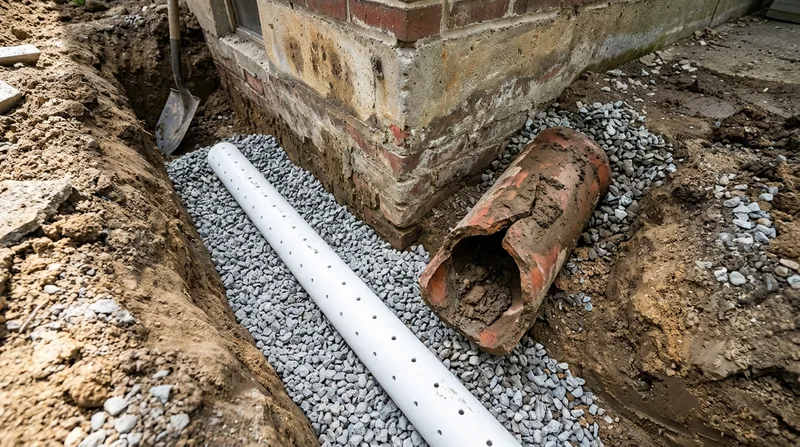




If you own a home in Greenville and you have water pooling along the foundation after every hard rain, the problem is often the original drain tile repair & replacement in Greenville system that was installed decades ago and has long since failed. Around downtown, College Hill, and the streets near East Carolina University, many 1920s to 1950s brick and frame houses still sit on their original clay tile footing drains, and those tiles are now cracked, root-bound, or full of silt. The ground here is flat coastal plain: sandy loam over silty clay with a high water table that stays wet for days after a storm. When the Tar River floodplain backs water up during tropical downpours, a dead drain tile has nowhere to send it, so it seeps into the basement or pushes against the footing. We repair and replace those systems with modern PVC and restore the drainage path your foundation was supposed to have. For a broader look at how this fits with the rest of your below-grade moisture control, see our basement waterproofing service.
Why Failed Drain Tile Matters in Greenville's Older Neighborhoods
Greenville's housing stock tells the story. The brick pier and slab homes around College Hill and the ECU campus were built before modern footing drains existed, and the 1950s to 1970s brick ranches in Brook Valley, Red Banks, and Westhaven were often built with clay tile that has simply outlived its service life. Add a high water table and slow runoff across the flat coastal plain, and a clogged or collapsed drain tile turns into a wet basement every time the ground saturates. The failure mode we see most is not a sudden break but a slow choke: roots from nearby pines and oaks find the joints, silt fills the pipe, and the system stops moving water altogether.
- Original clay tile lines crack and shift as the silty clay soil moves with wet and dry cycles.
- Tree roots from mature pines and hardwoods invade open joints and block the flow.
- Silt and sediment settle in low spots because the flat grade gives water little help.
- Downspouts and grading that dump water near the footing overload a drain that is already failing.
- Hydrostatic pressure builds when the drain cannot relieve the water table around the foundation.
When the drain tile stops working, the water does not disappear. It finds the path of least resistance, which is usually a foundation joint, a crack, or the cove where the wall meets the floor.
Key info: In Greenville's older river-adjacent blocks, we routinely camera a footing drain and find it half full of silt and root mass. That is not a crack-sealing problem. It is a drainage problem, and it needs the tile repaired or replaced before any wall repair will hold.
For the official word on when a drainage alteration needs a permit in our area, check the City of Greenville's permitting information at greenvillenc.gov, and always confirm current requirements with the local building department before work begins.
How We Diagnose and Replace Drain Tile Around Greenville
We do not guess at a drain problem. The first step is a camera inspection of the existing line so we can see exactly where it is broken, root-bound, or silted in. From there we map the run, check the sump basin and discharge, and decide whether a targeted repair will restore flow or whether the line is too far gone and needs replacement. On the flat lots common in Winterville and Ayden, grade matters more than people think, so we verify fall before we ever put pipe in the ground.
- We camera the existing drain tile and mark the failure points, root intrusions, and low spots.
- We check the sump basin, pump, check valve, and discharge line to confirm the system can move water once the tile is fixed.
- We excavate only where needed and remove collapsed or root-choked clay tile.
- We install new perforated PVC with filter fabric and washed gravel to keep silt out.
- We restore grade and test the full run with water before we close the trench.
Every job ends with a flow test, because a drain tile that has not been proven with water is just a pipe in a hole.
Local example: A 1940s brick home near College Hill had a basement that seeped after every summer storm. The camera showed the original clay tile crushed under a root mass from a mature pine. We replaced the failed run with PVC, tied it to a new sump basin, and the seepage stopped because the water finally had somewhere to go. If your situation points more toward an interior system, our interior drain tile system page explains that route.
Drain Tile Repair & Replacement Methods We Use
Not every failing drain needs the same fix. A single crushed section under a downspout is a different job from a fully silted clay line running the length of a foundation. The table below shows the approaches we use in Greenville and what each one is best suited for.
| Approach | Description | Best for |
|---|---|---|
| Targeted spot repair | Excavate and replace one crushed or root-blocked section of tile. | Isolated damage with the rest of the line still flowing. |
| Full PVC replacement | Remove failed clay tile and install new perforated PVC with gravel and filter fabric. | Old clay lines that are silted, root-bound, or collapsed along most of the run. |
| Interior perimeter drain | Cut a channel at the footing inside the basement and route water to a sump basin. | Homes where exterior excavation is impractical or the water is already inside. |
| Drain tile plus sump upgrade | Repair the tile and pair it with a new pump, check valve, and discharge line. | High water table lots where gravity alone will not move the water out. |
| Camera inspection only | Diagnose the line and document its condition before any repair decision. | Homeowners who need to know whether a repair or replacement is warranted. |
The right method depends on what the camera shows, not on what is easiest to sell. We tell you plainly when a spot repair is enough and when the line is too far gone.
Drain Tile Repair & Replacement Cost in Greenville: What to Expect
Most drain tile work in Greenville starts at From $750 for a targeted repair, and the price climbs from there based on how much of the line has failed. The biggest cost factors are the length of tile being replaced, how deep the line sits, whether tree roots have to be cut out, and how close the run is to the foundation, a driveway, or a mature pine that limits access. A camera inspection adds a modest amount but usually saves money by keeping the job targeted instead of open-ended.
Homes in the older neighborhoods near downtown often have deeper footing drains and more root intrusion, which pushes the job toward the higher end. Newer slab-on-grade subdivisions in Winterville and Ayden tend to have shallower runs and simpler access. Getting two or three estimates is smart because the scope can vary widely depending on what each contractor finds in the line. Our full pricing overview breaks down the ranges so you can compare apples to apples.
Key info: A quote that sounds too low often means the contractor plans to spot-patch without camera inspection. Ask whether the estimate includes a camera inspection and a flow test, because those two steps are what separate a real repair from a temporary patch.
Finding Drain Tile Repair & Replacement Near Me in Greenville
When you search for drain tile repair and replacement near me in Greenville, you will get a mix of dedicated waterproofing contractors, general foundation firms, and plumbers. They are not the same. A dedicated below-grade specialist reads the camera footage, understands hydrostatic pressure and the local water table, and knows when the real answer is an interior system rather than exterior excavation. Here is what to check before you hire anyone.
- Confirm the contractor is licensed and insured, and ask for a certificate of insurance before work starts.
- Get at least two or three written estimates so you can compare scope, not just price.
- Ask for local references from jobs in Greenville or nearby towns like Winterville, Ayden, or Farmville.
- Find out whether a permit is required for the drainage or discharge work, and confirm the contractor will pull it.
- Make sure the estimate spells out camera inspection, excavation, pipe material, gravel, and flow testing.
A contractor who cannot explain what the camera showed and why the repair is scoped the way it is has not done the diagnostic work. You can reach us through our contact page to set up a free basement inspection and get a straight answer on what your drain tile actually needs.
Drain Tile Repair & Replacement in Greenville: Pricing Guide
| Service | Price | Details |
|---|---|---|
| Targeted drain tile spot repair | Starting at $750 | Includes camera inspection, excavation of one failed section, new PVC, gravel, and flow test. |
| Full drain tile replacement (per run) | Starting at $1,800 | Removes failed clay tile and installs perforated PVC with filter fabric along the foundation. |
| Drain tile plus sump basin tie-in | Starting at $2,400 | Repairs the tile and connects it to a new sump basin, pump, check valve, and discharge line. |
| Deep or root-choked excavation | On estimate | Deeper footing drains, heavy pine root intrusion, or tight access near driveways need an on-site look. |
| Travel | Included | In Greenville and surrounding areas, no separate call-out or mileage fee. |
| Estimate | Free | Response within 24h at (252) 417-2783, no obligation to book. |
Indicative pricing, the exact cost depends on square footage, finish, and site access. Free personalized estimate within 24h at (252) 417-2783.


