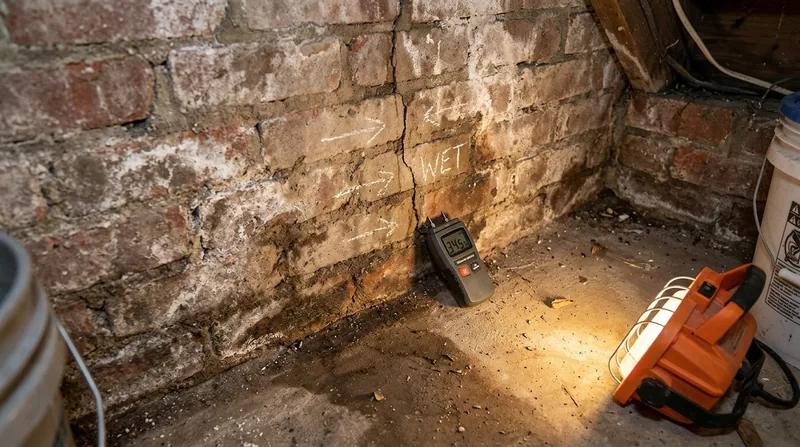




If you own a home in Greenville and you have seen water on the basement floor, a white chalky stain on the block, or a musty smell that will not leave, the first step is a free basement inspection in Greenville. We walk the below-grade space with you, check the walls, floor, cracks, sump system, grading and downspouts, and tell you plainly what needs fixing now and what can wait. Greenville sits on flat coastal plain ground, sandy loam over silty clay, with a water table that stays high after rain and slow runoff across the Tar River floodplain. Most houses here are on slab or brick piers, so the moisture problems we find are foundation cracks, failed sump pumps, window well backups and grading that pushes water toward the wall. Start with the basement waterproofing service page if you want the full picture of what we install.
Why a Free Basement Inspection Matters on Greenville's Flat, Wet Ground
Greenville does not have the deep basements you see up north, but it has something harder on foundations: a high water table and silty clay that holds water against the footing long after the storm passes. Around College Hill and the streets near East Carolina University, the 1920s to 1950s brick and frame houses sit on brick piers or slab, and the mortar joints and block walls show the first signs of hydrostatic pressure. In Brook Valley, Red Banks and Westhaven, the 1950s to 1970s brick ranches often have a sump pit that was added decades ago and never upgraded. A free inspection catches those problems while they are still cheap to fix.
- We check the foundation walls for efflorescence, which is the white salt bloom that tells you water is moving through the masonry.
- We test the sump pump, the check valve and the discharge line, because a failed pump is the number one cause of a wet basement floor after a summer downpour.
- We look at the grading and downspout extensions, since water that dumps at the wall will find the footing drain every time.
- We inspect window wells for debris and poor drainage, especially on the slab-on-grade homes in Winterville and Ayden.
- We photograph every crack and moisture stain so you have a record of the condition on the day of the visit.
You leave the inspection knowing which items are urgent, which can wait a season, and which are cosmetic.
Key info: A ranch in Westhaven with a damp block wall and a working sump pump usually needs crack sealing and a downspout extension, not a full perimeter drain. A house near the Tar River floodplain with water rising through the floor joint after tropical storms is a different conversation, and we say so on the spot.
For the official word on construction and trade permits in the city, check the City of Greenville building department before any structural work begins.
How Our Free Basement Inspection Works in Greenville
We schedule the visit within a few days, walk the below-grade space and the exterior perimeter with you, and keep the conversation in plain language. No pressure, no clipboard sales pitch. We start at the wall and work outward, because the source of the water is almost never where the stain shows up.
- We interview you first about when the water appears, after rain, during spring thaw, or all the time, because timing points to the cause.
- We inspect the foundation walls and floor joint for cracks, seepage and movement, and we note any bowing that needs monitoring.
- We test the sump pump, float, check valve and discharge line, and we check whether the pump runs long enough to keep the basin dry.
- We walk the exterior grading, gutter downspouts and window wells to see where roof water and surface water actually go.
- We photograph the findings and write up a short report with what to fix now, what to watch, and a straight answer if nothing is wrong.
If the inspection points to a drain tile problem, we explain the difference between repairing the existing system and installing a new interior perimeter drain, and you get the interior drain tile system details in writing.
Key info: On a 1960s brick ranch in Red Banks, we found a sump basin full of silt and a discharge line that ran three feet from the wall and dumped back against the foundation. The pump was fine. The installation was the problem. A new discharge line and a basin cleaning solved it for a fraction of what a new system would have cost.
Inspection Approaches We Use and What Each One Tells Us
Not every moisture problem needs the same diagnostic. We match the approach to the age and construction of the house, and we tell you which method we are using and why before we start.
| Approach | Description | Best for |
|---|---|---|
| Visual wall and floor walk | We inspect every wall, the floor joint, cracks and penetrations, and photograph the condition. | First visit on any home, especially older brick and block foundations. |
| Sump system test | We fill the basin, cycle the pump, and check the check valve, float and discharge slope. | Homes with an existing sump pit, common in 1950s to 1970s ranches. |
| Moisture meter scan | We read moisture content in the masonry and drywall to find hidden seepage paths. | Finished or semi-finished below-grade rooms with musty odors. |
| Exterior grading and drainage review | We check slope, downspout discharge, window wells and any ponding against the foundation. | Slab-on-grade homes in newer subdivisions where water pools at the wall. |
| Crack mapping | We measure and map crack width, direction and movement to judge whether injection or structural repair is right. | Homes with visible vertical or stair-step cracks in block walls. |
Each method answers a different question, and together they tell us whether you are looking at a simple crack, a drainage problem, or hydrostatic pressure that needs a real system.
Free Basement Inspection Cost in Greenville: What to Expect
The inspection itself costs nothing. We do not charge a call-out fee, a mileage fee or a diagnostic fee anywhere in Greenville and the surrounding towns. What you get for free is the walkthrough, the photos and the written explanation of what we found. The number that matters is what the repair costs, and that depends on the scope, not on the inspection.
Several factors move the repair price: the length of wall that needs work, whether the fix is crack injection or a full interior drain tile run, whether the sump pump needs replacement or just a new check valve, and how accessible the foundation is. A house on a tight lot near downtown Greenville with mature pines and a narrow side yard takes more labor to reach than an open lot in Ayden. We give you a written scope with the inspection, so you can compare it line by line against other estimates.
Getting two or three estimates is smart on any below-grade work, and we encourage it. Ask each contractor what they found, what they propose, and why. The full pricing overview shows typical ranges for our common repairs so you can sanity-check any quote you receive.
What to Look For When Hiring a Waterproofing Contractor Near Greenville
Below-grade work is hard to inspect after the fact, so the contractor you choose matters more than the brochure. Look for a company that specializes in basement and foundation moisture, not a general handyman who also does gutters. Ask for the license and insurance certificate, and call the references on jobs that are at least a year old.
- Confirm the company is licensed and insured and ask for the certificate before work starts.
- Get at least two or three written estimates with a clear scope, not a one-line price.
- Ask whether permits are required for your specific repair, and verify with the local building department since rules vary by jurisdiction.
- Check references for jobs similar to yours, especially sump pump replacements and crack injections.
- Ask how they handle warranty terms and whether the warranty is transferable if you sell the house.
If a contractor cannot explain in plain language why they are recommending a repair, keep looking. You can contact us for a free estimate and we will walk you through the findings without pressure.
Free Basement Inspection Near Me: What Greenville Homeowners Should Know
When you search for a free basement inspection near me in Greenville, you are usually dealing with a symptom that just showed up: water on the floor after a storm, a musty smell in a finished room, or a sump pump that runs constantly. The inspection is the fastest way to sort out which of those is urgent. We cover Greenville and the surrounding towns, including Winterville, Ayden, Farmville, Grifton, Kinston, Washington, Wilson, Snow Hill, Williamston, Robersonville, Hookerton, Tarboro, Vanceboro, Jamesville and Bethel.
The dominant failure mode in this city is water backing up against the foundation after heavy rain, driven by the high water table and slow runoff on flat ground. That is why we look at grading and downspouts on every visit, not just the walls. If you are in the 27834 ZIP code, the Greenville inspection page has the local details, and the Winterville page covers the newer slab subdivisions to the south.
Book the inspection before the next tropical system arrives. It is free, it takes about an hour, and you will know exactly where you stand.
Free Basement Inspection in Greenville: Pricing Guide
| Service | Price | Details |
|---|---|---|
| Free basement inspection | Free | Full walkthrough, photos and written findings at no cost, no call-out fee anywhere in Greenville. |
| Crack injection (epoxy or polyurethane) | Starting at $450 | Per crack, includes ports and sealing; price moves with crack length and wall access. |
| Sump pump replacement | Starting at $850 | Pump, check valve and discharge line; price moves with basin condition and discharge run length. |
| Interior drain tile system | On estimate | Priced per linear foot after inspection; scope depends on wall length and footing access. |
| Travel | Included | In Greenville and surrounding areas, no separate call-out or mileage fee. |
| Estimate | Free | Response within 24h at (252) 417-2783, no obligation to book. |
Indicative pricing, the exact cost depends on square footage, finish, and site access. Free personalized estimate within 24h at (252) 417-2783.


