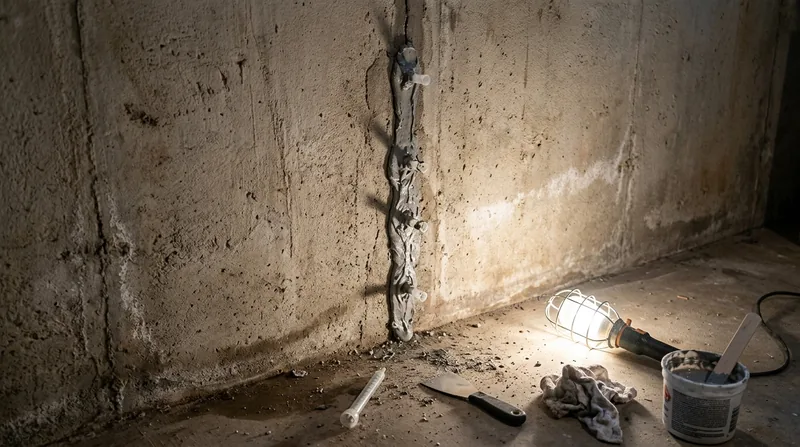




If you have a crack in your foundation wall in Greenville, you already know the pattern: a hairline that shows up after a wet spring, a stain that spreads across the block, or a white chalky bloom on the brick pier. Foundation crack repair in Greenville is our core trade, and we handle it as a diagnostic job first, a repair second. This city sits on flat coastal plain, sandy loam over silty clay, with a water table that stays high after every heavy rain. Around College Hill and the streets near East Carolina University, most houses are 1920s to 1950s brick and frame on brick piers or slab. Out in Brook Valley, Red Banks and Westhaven, the 1950s to 1970s ranches are mostly slab or raised pier. Full basements are uncommon here, so the cracks we see are usually in foundation walls, pier footings and slab edges, not deep basement walls. We inspect every crack, tell you whether simple sealing is enough or whether hydrostatic pressure is the real problem, and match the repair to the wall instead of patching blind. If you want the wider picture of how water moves against a foundation here, start with our foundation waterproofing service.
Why Foundation Cracks Show Up So Often in Greenville's Soil and Water Table
Greenville's ground is flat and slow to drain. Sandy loam sits over silty clay, so rainwater perches, the water table rises, and the soil pushes against foundation walls with real hydrostatic pressure. Add the Tar River floodplain backing water up after tropical storms, and you get saturated soil for days. The other half of the problem is the building stock: older brick pier foundations and slab-on-grade homes in Winterville and Ayden move with seasonal wet and dry cycles, and short winter freezes open hairline cracks a little wider each year.
- Hydrostatic pressure pushes water through hairline cracks and cold joints after heavy downpours.
- Seasonal shrink and swell in silty clay pulls walls away from pier footings and slab edges.
- Efflorescence, the white mineral bloom on brick and block, shows water is moving through the masonry.
- Downspouts that dump next to the foundation concentrate water right at the crack.
- Settling pier foundations in older downtown homes create diagonal cracks that need structural review, not just a patch.
None of these cracks fix themselves, and a cosmetic patch over an active leak usually fails within a season.
Key info: A 1950s brick ranch in Westhaven with a stair-step crack near the corner is a classic Greenville case. The crack is often driven by a downspout discharging at the foundation plus clay soil holding water, not by a structural failure. We check the grading and the discharge before we ever quote an injection.
For the official local rules on structural repair permits, check the City of Greenville's building inspections page at greenvillenc.gov before work begins.
How We Diagnose and Repair Foundation Cracks in Greenville, Step by Step
We do not sell one repair method for every crack. A hairline shrinkage crack in a slab edge and an actively leaking crack under hydrostatic pressure are different jobs. Our process starts with the crack itself, then works outward to grading, drainage and soil conditions, because in Greenville the water source is usually the deciding factor.
- We inspect the crack width, direction and depth, and check for efflorescence, staining and movement.
- We look at grading, downspout discharge and any ponding against the foundation after rain.
- We determine whether the crack is non-structural (shrinkage, settlement hairline) or structural (wide, offset, or actively moving).
- For non-structural cracks, we inject epoxy or polyurethane through injection ports to fill the full depth of the crack.
- For wider or shifting cracks, we evaluate carbon fiber straps or wall anchors where the wall is bowing or the soil is pulling on it.
- We correct the water source where needed, extending downspouts and regrading so the repair is not fighting the same water next season.
- We document the repair and give you a transferable warranty on the work.
Every step is explained before we start, and you get a written scope, not a verbal guess.
Key info: In a Winterville subdivision built in the 2000s on slab-on-grade, we commonly find a single vertical crack at mid-wall with dampness but no structural movement. Polyurethane injection closes it and stays flexible through the seasonal movement that cracked it in the first place. A rigid patch would simply re-crack.
If the inspection shows water is entering along the whole wall rather than one crack, the better answer is usually an interior drain tile system that manages water at the footing instead of chasing cracks one at a time.
Foundation Crack Repair Methods We Use in Greenville
The right method depends on crack width, whether the wall is moving, and how much water pressure sits behind it. Here is how the main approaches compare for Greenville-area homes.
| Approach | Description | Best for |
|---|---|---|
| Epoxy injection | Structural epoxy injected through ports bonds the crack faces back together and restores wall strength. | Dry, non-moving structural cracks in poured concrete and block walls. |
| Polyurethane injection | Flexible foam expands into the crack and seals active leaks, even with water present. | Leaking cracks under hydrostatic pressure and cracks that move seasonally. |
| Carbon fiber straps | Straps bolt to the wall and resist inward bowing without excavation. | Bowing or cracked block walls where the soil is pushing inward. |
| Wall anchors | Anchors driven into stable soil outside pull a moving wall back toward plumb. | Walls with significant lateral movement or rotation. |
| Surface sealing and parging | Hydraulic cement and parging close surface defects and prepare the wall. | Minor hairline cracks and cosmetic repair of masonry surfaces. |
We match the method to the crack, and we tell you plainly when a simple seal is enough and when pressure behind the wall means a drainage fix comes first.
Foundation Crack Repair Cost in Greenville: What to Expect
Crack repair is one of the more predictable jobs in this trade, but the price still moves with the crack. A single non-structural crack sealed with injection starts around $450. Wider cracks, cracks with active water pressure, multiple cracks on one wall, or a crack that turns out to need carbon fiber straps all push the number up. Access matters too: a crack behind mature shrubs or tight against a fence line takes longer to reach.
We quote after inspecting the crack, not over the phone, because the difference between a $450 injection and a structural repair is something you can only see up close. Get two or three estimates and compare scope, not just the total. A low quote that only patches the surface will not hold through a Greenville wet season.
Our full breakdown of rates and what each job includes is on the pricing page.
Foundation Crack Repair Near Me: How to Choose a Contractor Near Greenville
Hiring for crack repair is mostly about verification. Ask for the license and insurance certificate, get more than one written estimate, and ask for references from jobs in Greenville or nearby towns like Ayden, Farmville or Grifton. A contractor who has worked this coastal plain soil knows what a pressure crack looks like versus a settlement crack.
- Confirm the contractor is licensed and insured, and ask for the certificate directly.
- Get two or three written estimates that describe the method, not just a price.
- Ask for references on similar homes, especially slab or pier foundations.
- Ask who pulls any permit, since structural repair and drainage changes often require one.
- Read the warranty terms and confirm they are transferable.
A straight answer about what your crack actually needs is worth more than the lowest bid.
Call (252) 417-2783 or use our contact page to schedule an inspection. We serve Greenville and the surrounding towns, and the estimate is free.
Foundation Crack Repair in Greenville: Pricing Guide
| Service | Price | Details |
|---|---|---|
| Single hairline crack injection | Starting at $450 | Covers epoxy or polyurethane injection of one non-structural crack, ports and sealing included |
| Multiple cracks on one wall | Starting at $750 | Each additional crack adds time and material; price rises with crack count and width |
| Structural repair with carbon fiber straps | On estimate | Bowing or moving walls need an on-site assessment before a number is given |
| Travel | Included | in Greenville and surrounding areas, no separate call-out or mileage fee |
| Estimate | Free | Response within 24h at (252) 417-2783, no obligation to book |
Indicative pricing, the exact cost depends on square footage, finish, and site access. Free personalized estimate within 24h at (252) 417-2783.


