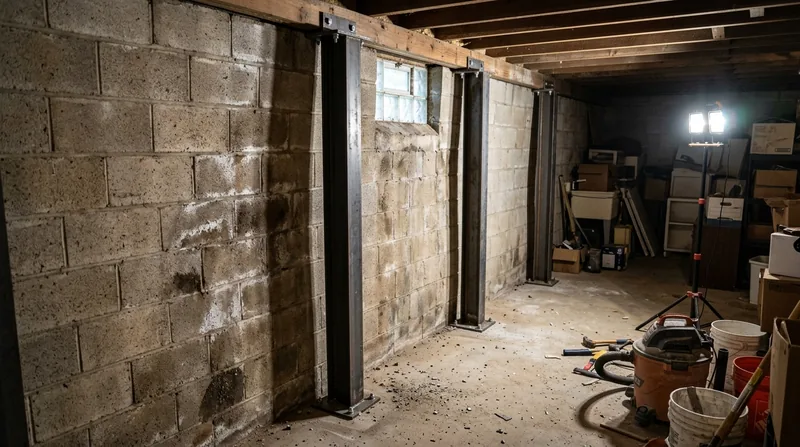




Bowing Wall Repair in Greenville: When Wet Soil Pushes Back
Greenville sits on flat coastal plain ground, sandy loam over silty clay, with a water table that stays high long after the rain stops. In the 1920s to 1950s brick and frame houses around downtown, College Hill, and the streets near East Carolina University, many of those foundation walls are original block or brick laid decades ago in ground that never really dries out. That is where Bowing Wall Repair in Greenville becomes a real conversation, because a wall that leans or bulges inward is telling you the saturated soil behind it is winning. We specialize in below-grade work only, and we read wall movement for what it is: hydrostatic pressure that has built up against a foundation wall that was never designed for it.
If you are seeing a curve in a block wall, a horizontal crack at mid-height, or a wall pulling away from the floor joists above, start with a free basement inspection so we can measure the movement before it gets worse. The fix depends on severity, and we will tell you plainly when straps are enough and when the wall needs anchors or steel.
Why Bowing Walls Are Common in Greenville's Older Brick and Block Foundations
The Tar River floodplain backs water up after tropical storms and heavy downpours, and the flat ground around Brook Valley, Red Banks, and Westhaven drains slowly. When that water sits against a block foundation wall, it creates hydrostatic pressure that pushes inward, and a wall with years of efflorescence and mortar joint wear has little reserve left. The freeze-thaw cycle here is short but real, and each winter loosens the mortar a little more.
- You see a visible inward curve or lean when you sight down the wall from one end.
- Horizontal cracks appear at mid-height, often wider on the inside face than the outside.
- Doors and windows above the wall start sticking because the frame has racked.
- Efflorescence and white mineral staining show water has been moving through the block for years.
- Grading slopes toward the house and downspouts dump water right at the foundation line.
Any one of these is worth a look, and two or more together mean the pressure behind the wall is active right now.
Key info: A block wall in a 1940s College Hill house that bulges a half inch over eight feet is a different job from a wall that has moved two inches. We measure the bow, check the mortar, and look at the soil side before recommending carbon fiber straps or wall anchors.
For official guidance on structural repair permits, check the City of Greenville's building inspections department before any work begins: City of Greenville, NC.
How We Repair a Bowing Wall in Greenville, Step by Step
We do not guess at wall repair. Every job starts with measuring the movement and identifying where the water pressure is coming from, because a strap on a wall with no drainage correction is a temporary fix. Our process is built around stopping the movement first and relieving the pressure second.
- We inspect the wall inside and out, measure the bow with a plumb line, and map the crack pattern.
- We check grading, downspout discharge, and the footing drain to see where water is collecting.
- We recommend the right structural method: carbon fiber straps for moderate bowing, wall anchors or steel I-beams for severe movement.
- We install the repair and, where needed, correct the drainage so the pressure does not return.
- We document the pre-repair measurement so you have a baseline to compare against later.
The structural repair holds the wall; the drainage work is what keeps it from moving again.
Key info: On a 1960s ranch in Westhaven, we found a block wall bowing an inch and a half with a downspout discharging six inches from the corner. We installed carbon fiber straps, extended the downspout, and regraded the side yard. Two years later the measurement had not moved.
If the wall movement comes with water on the floor, pair the structural repair with an interior drain tile system so the hydrostatic pressure has somewhere to go.
Bowing Wall Repair Methods We Use
Not every bowing wall needs the same fix. We match the method to the severity of the movement and the soil pressure behind the wall, and we explain the tradeoffs before you commit.
| Approach | Description | Best for |
|---|---|---|
| Carbon fiber straps | Straps bonded vertically to the inside face and anchored top and bottom to stop further movement. | Moderate bowing up to about two inches with sound mortar. |
| Wall anchors | Steel plates on the inside tied to anchors driven into stable soil outside the wall. | Walls that have moved beyond two inches or are still actively moving. |
| Steel I-beams | Vertical beams set against the wall and tied into the floor and joists above. | Severe bowing or walls with heavy block deterioration. |
| Drainage correction | Regrading, downspout extensions, and footing drain work to relieve hydrostatic pressure. | Every bowing wall job, because pressure is the root cause. |
We will not sell you anchors when straps will do the job, and we will not strap a wall that needs steel.
Bowing Wall Repair Cost in Greenville: What to Expect
Most bowing wall repairs in Greenville start from $600 for a straightforward strap installation on a single wall section, and the price climbs from there based on how far the wall has moved and how much drainage correction is needed. A wall that needs anchors or steel beams is a larger structural job, and the cost reflects the engineering and the excavation involved.
The biggest factors are the length of the wall, the severity of the bow, the number of straps or anchors required, and whether the footing drain and grading need work at the same time. Access matters too: a wall behind a finished basement or a tight side yard takes more labor than an open one. We recommend getting two or three estimates and comparing the scope, not just the number, because a cheap strap job that ignores the water pressure will not hold.
See the full pricing overview for a detailed breakdown, and call (252) 417-2783 to schedule a free inspection.
What to Look for When Hiring a Bowing Wall Repair Contractor Near Greenville
Bowing wall repair is structural work, and the contractor you hire should be able to show you licensed and insured status, explain the method they recommend, and put the scope in writing. Ask how they measure the bow, whether they correct drainage at the same time, and what warranty they offer on the repair. A transferable warranty is standard on quality work; a lifetime promise is not.
Check references from jobs in Greenville and the surrounding towns, and confirm the contractor pulls the right permits with the local building department, since structural foundation repair commonly requires one and the rules vary by jurisdiction. If your neighborhood has HOA requirements, get those in writing before work starts. Reach us through the contact page to set up an inspection.
Bowing Wall Repair in Greenville: Pricing Guide
| Service | Price | Details |
|---|---|---|
| Carbon fiber strap installation (single wall) | Starting at $600 | Covers measuring, strap bonding, and anchoring on one wall section with moderate bowing. |
| Wall anchor system | Starting at $1,800 | Includes exterior anchor plates and rods for walls that have moved beyond two inches. |
| Steel I-beam reinforcement | Starting at $3,500 | For severe bowing or deteriorated block, priced by wall length and beam count. |
| Drainage correction add-on | Starting at $450 | Regrading and downspout extensions to relieve hydrostatic pressure at the wall. |
| Complex or large-scale job | On estimate | Multi-wall movement or finished basement access needs an on-site look before pricing. |
| Estimate | Free | Response within 24 hours at (252) 417-2783, no obligation to book. |
Indicative pricing, the exact cost depends on square footage, finish, and site access. Free personalized estimate within 24h at (252) 417-2783.


