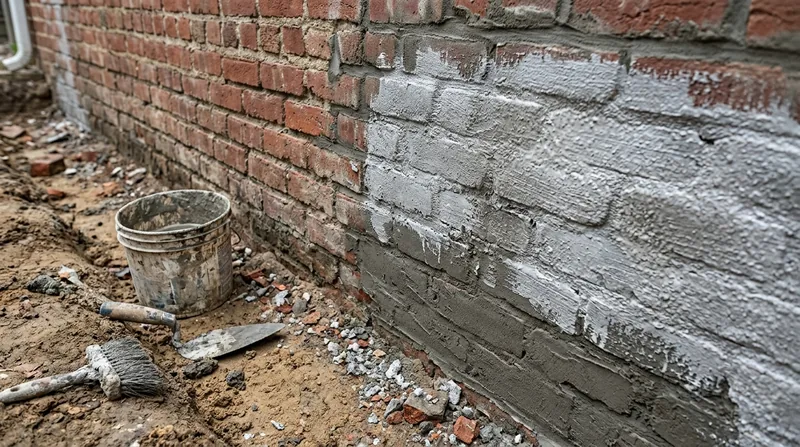




If you own a home in Greenville, you already know the ground here holds water. The flat coastal plain sits on sandy loam over silty clay, and the water table stays high long after a summer downpour or a tropical storm pushes the Tar River floodplain back up. Foundation Waterproofing in Greenville is the work of keeping that water out of your basement and away from your footings, and we do it on the foundation types this city actually has: 1920s brick piers around College Hill, slab and raised pier ranches in Brook Valley and Westhaven, and slab-on-grade subdivisions out toward Winterville and Ayden. Most homes here have no full basement, so the real calls are wall seepage, footing saturation, cracked block, and sump pumps that quit during the storm that mattered. We are a dedicated below-grade waterproofing contractor, not a general foundation firm and not a plumber, and we tell you plainly when a crack is cosmetic and when hydrostatic pressure is the actual problem. Start with a free basement inspection and we will show you what the water is doing.
Why Foundation Waterproofing Matters on Greenville's Flat, Wet Ground
Greenville gets the worst of both worlds: heavy rain and nowhere for it to run. The silty clay under the sandy top layer drains slowly, so water stacks up against the foundation and pushes inward as hydrostatic pressure. That is why brick pier homes near East Carolina University show white efflorescence on the pier faces, and why 1970s ranches in Red Banks get damp block walls after every multi-day rain. The failure mode that dominates here is not frost heave, it is saturated soil that never gets a chance to dry out.
- Hydrostatic pressure forces water through block mortar joints and hairline cracks long before you see a puddle.
- Footing drains and old weeping tile clog with clay fines and stop moving water away from the wall.
- Downspouts that dump within two feet of the foundation send roof water straight into the same soil.
- Sump pumps sized for a dry year fail during the tropical remnants that hit the Tar River floodplain.
- Bowing block walls in older pier homes need carbon fiber straps or wall anchors, not another coat of sealer.
None of this improves on its own, and a wet wall in July is a wet wall every July after that.
Key info: A 1950s brick ranch in Westhaven with efflorescence at the wall base and a musty basement smell almost never has a single crack problem. It has a drainage problem, and sealing the wall without correcting the water behind it just traps the moisture.
Permits for structural foundation repair and for work that alters drainage vary by jurisdiction, so confirm the current rules with the City of Greenville building department before any structural work begins: City of Greenville, NC.
How We Diagnose and Waterproof a Greenville Foundation
We start below grade and work outward, because the fix has to match the foundation you actually have. A poured wall takes epoxy or polyurethane injection differently than a brick pier takes parging and repointing. We read the wall, the soil, the grading, and the discharge before we quote anything, and we tell you when simple crack sealing is genuinely enough.
- We walk the interior and exterior, map crack direction, and check for efflorescence, rust stains, and wall movement.
- We test the water table behavior after rain and confirm whether the sump basin and check valve are holding.
- We inspect grading and downspout extension, since surface water is the cheapest problem to fix first.
- We recommend the method: injection, parging and membrane, interior perimeter drain, or exterior excavation.
- We pull the required permit when structural repair or drainage alteration crosses the local threshold.
- We test the sump pump and discharge line before we leave, and we set up a transferable warranty in writing.
Every recommendation comes with the reasoning, so you can compare our scope against another bid line for line.
Key info: On a slab-on-grade home in Winterville, the water usually shows up at the wall base and under the flooring, not in a basement. We correct the grading, extend the downspouts, and cut in an interior perimeter drain tied to a sump basin, which is far less disruptive than digging out a footing that has nowhere to drain.
If the diagnosis points to exterior work, we detail that scope on our exterior basement waterproofing page.
Waterproofing Methods We Match to Greenville Foundations
There is no single product that fixes every wall, and any contractor who says otherwise is selling a tube of sealer. The table below shows the approaches we use and the foundation conditions each one fits in this city.
| Approach | Description | Best for |
|---|---|---|
| Epoxy injection | Ports drilled along the crack, resin injected to bond the concrete back together. | Non-moving poured wall cracks that are leaking. |
| Polyurethane injection | Flexible foam that expands into wet cracks and stays pliable. | Active leaks and cracks that may move slightly. |
| Parging and membrane | Exterior mortar coat with dimple board or waterproof membrane over it. | Block and older brick walls with surface seepage. |
| Interior perimeter drain | Drain tile at the footing inside, leading to a sump basin and pump. | High water table and pressure that will not stop. |
| Carbon fiber straps and anchors | Structural reinforcement for walls that are bowing inward. | Moving block walls in older pier-foundation homes. |
Foundation Waterproofing Cost in Greenville: What to Expect
Most residential foundation waterproofing work here starts at From $3,500, and that figure buys a defined scope, not a vague promise. A single crack injection sits at the low end. A full interior perimeter drain with a sump basin and discharge line sits well above it. The number moves with foundation type, linear footage, access, and how much of the water is coming from grading you can fix cheaply.
- Foundation type drives the method: poured walls take injection, brick piers take parging and repointing.
- Linear footage of drain tile and the number of sump basins set the base cost.
- Access matters: a tight side yard off a College Hill alley costs more labor than an open lot in Ayden.
- Wall movement changes the scope entirely, since bowing walls need straps or anchors before waterproofing.
- Discharge routing and permit requirements add line items you should see spelled out, not buried.
Get two or three written estimates on the same scope, and be suspicious of any bid that skips the diagnosis and quotes a number over the phone. Our full pricing overview shows how the line items break down.
Choosing a Foundation Waterproofing Contractor Near Me in Greenville
The right contractor will walk your foundation, explain the difference between a crack and a pressure problem, and put the scope in writing. The wrong one sells you a sealer coat and disappears. Ask the same questions of every bidder and compare answers, not just prices.
- Confirm the company is licensed and insured, and ask for a certificate before work starts.
- Get at least two or three estimates on identical scope so the comparison is real.
- Ask for local references on homes with your foundation type, not just any job.
- Ask who pulls the permit for structural repair or drainage alteration and confirm it with the city.
- Check HOA rules for exterior excavation, discharge routing, and equipment access before signing.
We answer those questions on the first call, and you can reach us through our contact page to set up the walkthrough.
Foundation Waterproofing in Greenville: Pricing Guide
| Service | Price | Details |
|---|---|---|
| Crack injection (epoxy or polyurethane) | Starting at $3,500 | Includes port drilling, resin injection, and cleanup; price rises with crack length and number of leaks. |
| Parging and membrane on block or brick | Starting at $4,200 | Exterior mortar coat plus dimple board; cost moves with wall height and access to the footing. |
| Interior perimeter drain with sump basin | On estimate | Linear footage, basin count, and discharge routing vary too much per home to quote blind. |
| Bowing wall reinforcement | On estimate | Carbon fiber straps or anchors require an on-site structural look before any number is given. |
| Travel | Included | In Greenville and surrounding areas, no separate call-out or mileage fee. |
| Estimate | Free | Response within 24h at (252) 417-2783, no obligation to book. |
Indicative pricing, the exact cost depends on square footage, finish, and site access. Free personalized estimate within 24h at (252) 417-2783.


